
...was the start of anticipation of fanatics everywhere, responding to the news. You may not be reading it here first, but you can probably imagine my current state of mind...
Press Release
Source: Columbia Records
KATE BUSH; New Single & Album
Wednesday August 31, 5:00 am ET
NEW YORK, Aug. 31 /PRNewswire/ -- Columbia Records is proud to announce the release of the brand new studio album by Kate Bush.
The double album entitled 'Aerial' will be released worldwide on November 8th (Nov 7th in Europe).
The first single 'King Of The Mountain' precedes the album on September 27th. It will be available online at iTunes, Yahoo! Music Unlimited, Sony Connect, Walmart.com, Rhapsody, Napster, and MSN Music.
Both the single and album are produced by Kate Bush.
Tick tick tick tick tick tick tick tick tick...
L
Wednesday, August 31, 2005


Thursday, August 25, 2005
Vote Now!
Well, in continuing coverage of my library addiction, I direct your attention to Edmonton Public Library's contest, The Last Word, which asks patrons to name their favourite Alberta book. If you have an EPL account (or maybe even a TAL or NEOS account), you are eligible to win a big collection of Alberta books. I have already entered, of course, and nominated No Fixed Address by Aritha van Herk, a delightfully funny, intelligent read. But notice that several of Lois Hole's books appear on the list, and I'll Never Marry a Farmer is highly ranked, currently with six votes (the top book has twelve, for the sake of comparison). Wow!
I am enjoying my final two weeks of holidays very much and have been reading a lot. In addition to many, many articles on postcolonialism and other relevant scholarly topics, last week I read three books that offered some moments of fascinating juxtaposition. My little brain is smokin'!
First, as mentioned earlier, I read Stephanie Coontz's study Marriage, A History. It is a suitably academic tome with fully 98 pages of notes and an 18-page index. The back jacket provides complimentary blurbs from close to a dozen scholars and cultural authorities. With an apparatus like that, I was expecting to be impressed, and for the first few chapters I was. However, as Coontz moved into the early twentieth century (a period I have more than passing familarity with), I realized exactly how superficial and selective her argument is. Although she provides a breathtaking range of sources and quotations, her analysis of changing gender roles post-WWI is suspect, making me wonder about the solidity of the discussion leading up to it. Beyond her relentless American bias, she ignores many significant social facts — for instance, the social impact of the World War One itself and the flu pandemic of the late 1910s. As she moves into the post-war period, her analysis becomes even more glib, as if the facts of our culture are so self-evident as to need no explanation (if that were true, how could she justify writing her book in the first place?). Coontz's final conclusion — that the male breadwinner marriage of the 1950s and early 1960s was a carefully constructed historical aberration unlikely to be seen again in our culture of increasing individualism — is not groundbreaking, and her placid call for patience while the concept of marriage continues to sort itself out feels disappointingly flat after some 300 pages of build-up. I did like her busting of several common marriage myths regularly trotted out by mass media to drive political and economic agendas (for instance, that single women over 35 are more likely to be killed by terrorists than married — obviously untrue, and not because the women are so panicked that they'll marry any man who offers a ring). But in the end I was not impressed by this book as I was by, say, The Meaning of Wife.
Immediately after finishing with Coontz — perhaps as an antidote? — I read Melvin Burgess' YA novel Doing It. This is a surprisingly complex story told by alternating narrators, predominantly three seventeen-year-old males preoccupied with sex. One young man is involved with a young woman almost as self-absorbed as he is, the second is struggling with dating a young woman whose body does not confirm to his peer group's stereotypes, and the third is trying to extricate himself from an abusive relationship with his drama teacher. Be warned: this novel is not for those with delicate sensibilities. The word fuck appears on virtually every page in some form or another, and the main characters' thoughts about sexuality are unabashedly frank. Interestingly, some attitudes identified by Coontz are engaged here as the various narrators negotiate the social, cultural, and physical boundaries around sex. I have some trouble anticipating the readership for this novel, however: I can't see many boys age fourteen-plus reading this sort of book (other than perhaps skimming it for titillation value), and I expect that many girls in the YA age-group would be put off by the males' attitudes (it would be unfortunate if I'm right, though, because teenage girls could learn a lot about "how the other half lives" from this book). Burgess is a fine writer who handles uncomfortable scenes with sensitivity and honesty — there was a lot about this book to like. Just don't expect to find it in every high school library.
I heard Susan Jane Gilman's memoir Hypocrite in a Pouffy White Dress discussed by a book panel on the CBC (before the workers were locked out, of course). Gilman is only slightly older than I am, and the subtitle of the book, Tales of Growing Up Groovy and Clueless, got me instantly. The first two sections of this book made me laugh out loud regularly; Gilman recounts her childhood and adolescence in loopy, original prose that is delicious, occasionally dazzling. The guys had to sit through many, many passages bracketed by "Just listen to this... Don't you wish you'd written that?". I enjoyed the book overall but felt the final section, which describes Gilman's university experiences and early career (ending with her recent move to Switzerland), loses much of the charm of the earlier chapters. Gilman's account of her parents' divorce is unbelievably whiny, and her story of working in Washington is almost hopelessly naive — here the "clueless" of the subtitle certainly rings true. Women in their thirties may find Gilman's embarrassed enchantment with her wedding dress poignant, but her bride stories are so much better when Susan Jane is a kindergartener who insists on wearing a tutu to class every day. Hypocrite is definitely worth your time, but don't expect insightful feminist analysis or deep cultural commentary. Gilman is at her best in the voice of a girl becoming a young woman, and I hope she will continue to mine this vein — perhaps through YA narrative?
Well, that was last week!
The other day I finished Roddy Doyle's Oh, Play That Thing, the continuing tale of Henry Smart. I adored the first Henry novel, A Star Called Henry, and have been eagerly waiting to get the new installment from the library. I was not disappointed. The last thirty pages were riveting — they left me breathless — and I can only hope the next book comes soon. I didn't know much about Louis Armstrong prior to reading the novel, but I'm motivated now to learn more (although when I'll do that exactly is uncertain...). The particular copy I borrowed was filled with surprisingly angry marginal notes, scribbled (in pencil) by someone much less charmed by Henry, and by Doyle's use of source materials, than I was — they added an unusual, but not negative, dimension to the reading.
Oh, and I wanted to mention another book that I devoured a few weeks ago. My Father Had a Daughter by Grace Tiffany is another reconstruction of Shakespeare, this one told from the perspective of Judith Shakespeare, Will's daughter. Judith is a richly developed, appealing narrator that you won't soon forget. The intended readership is YA, but the author is an American Shakespeare scholar, so her speculations are well grounded in research and the story should satisfy any adult reader. Interestingly, the text covers some of the same material as the play we saw earlier this year, Shakespeare's Will — comparing the authors' treatment of the extant facts could lead to some fertile discussion. But that's for someone else to pursue — Shakespeare's not really my guy (although earlier we were discussing the idea that someone might write a five-act history of Elizabeth I in the style of Shakespeare...).
I should also mention Marjane Satrapi's Persepolis, my second experience with the graphic narrative form. (My first was Blankets by Craig Thompson, which made me cry — it is so gentle and wistful.) Persepolis isn't technically a graphic "novel" because its story is the author's own memoir of her childhood in Iran. I am ashamed to admit how little I knew and know about Iranian history; thankfully, the book includes a quick primer to contextualize Marjane's story. This book also made me cry, all the more so because of its continuing resonance. I quickly learned to love the young Marjane, and her parents' decision at the end of the story is heartbreaking. I will be watching for more from Satrapi — she writes and illustrates in France — and I'm grateful to the friend who recommended this wonderful book.
I'm currently struggling through Everything Bad Is Good for You: How Today's Popular Culture Is Actually Making Us Smarter by Steven Johnson — not at all what I expected. And as I mentioned, I'm back to reading fairly academic stuff in preparation for my continuing course work. I have a pile of YA requested at various libraries, plus a few other books to try to finish before the school year starts. And I've been watching movies on video during the days I'm at home. It's been a text-rich summer, in short, and I'm looking forward to going back to school with a head full of new ideas and lots of fresh energy. So... wish me luck!
with love,
L
Well, in continuing coverage of my library addiction, I direct your attention to Edmonton Public Library's contest, The Last Word, which asks patrons to name their favourite Alberta book. If you have an EPL account (or maybe even a TAL or NEOS account), you are eligible to win a big collection of Alberta books. I have already entered, of course, and nominated No Fixed Address by Aritha van Herk, a delightfully funny, intelligent read. But notice that several of Lois Hole's books appear on the list, and I'll Never Marry a Farmer is highly ranked, currently with six votes (the top book has twelve, for the sake of comparison). Wow!
I am enjoying my final two weeks of holidays very much and have been reading a lot. In addition to many, many articles on postcolonialism and other relevant scholarly topics, last week I read three books that offered some moments of fascinating juxtaposition. My little brain is smokin'!
First, as mentioned earlier, I read Stephanie Coontz's study Marriage, A History. It is a suitably academic tome with fully 98 pages of notes and an 18-page index. The back jacket provides complimentary blurbs from close to a dozen scholars and cultural authorities. With an apparatus like that, I was expecting to be impressed, and for the first few chapters I was. However, as Coontz moved into the early twentieth century (a period I have more than passing familarity with), I realized exactly how superficial and selective her argument is. Although she provides a breathtaking range of sources and quotations, her analysis of changing gender roles post-WWI is suspect, making me wonder about the solidity of the discussion leading up to it. Beyond her relentless American bias, she ignores many significant social facts — for instance, the social impact of the World War One itself and the flu pandemic of the late 1910s. As she moves into the post-war period, her analysis becomes even more glib, as if the facts of our culture are so self-evident as to need no explanation (if that were true, how could she justify writing her book in the first place?). Coontz's final conclusion — that the male breadwinner marriage of the 1950s and early 1960s was a carefully constructed historical aberration unlikely to be seen again in our culture of increasing individualism — is not groundbreaking, and her placid call for patience while the concept of marriage continues to sort itself out feels disappointingly flat after some 300 pages of build-up. I did like her busting of several common marriage myths regularly trotted out by mass media to drive political and economic agendas (for instance, that single women over 35 are more likely to be killed by terrorists than married — obviously untrue, and not because the women are so panicked that they'll marry any man who offers a ring). But in the end I was not impressed by this book as I was by, say, The Meaning of Wife.
Immediately after finishing with Coontz — perhaps as an antidote? — I read Melvin Burgess' YA novel Doing It. This is a surprisingly complex story told by alternating narrators, predominantly three seventeen-year-old males preoccupied with sex. One young man is involved with a young woman almost as self-absorbed as he is, the second is struggling with dating a young woman whose body does not confirm to his peer group's stereotypes, and the third is trying to extricate himself from an abusive relationship with his drama teacher. Be warned: this novel is not for those with delicate sensibilities. The word fuck appears on virtually every page in some form or another, and the main characters' thoughts about sexuality are unabashedly frank. Interestingly, some attitudes identified by Coontz are engaged here as the various narrators negotiate the social, cultural, and physical boundaries around sex. I have some trouble anticipating the readership for this novel, however: I can't see many boys age fourteen-plus reading this sort of book (other than perhaps skimming it for titillation value), and I expect that many girls in the YA age-group would be put off by the males' attitudes (it would be unfortunate if I'm right, though, because teenage girls could learn a lot about "how the other half lives" from this book). Burgess is a fine writer who handles uncomfortable scenes with sensitivity and honesty — there was a lot about this book to like. Just don't expect to find it in every high school library.
I heard Susan Jane Gilman's memoir Hypocrite in a Pouffy White Dress discussed by a book panel on the CBC (before the workers were locked out, of course). Gilman is only slightly older than I am, and the subtitle of the book, Tales of Growing Up Groovy and Clueless, got me instantly. The first two sections of this book made me laugh out loud regularly; Gilman recounts her childhood and adolescence in loopy, original prose that is delicious, occasionally dazzling. The guys had to sit through many, many passages bracketed by "Just listen to this... Don't you wish you'd written that?". I enjoyed the book overall but felt the final section, which describes Gilman's university experiences and early career (ending with her recent move to Switzerland), loses much of the charm of the earlier chapters. Gilman's account of her parents' divorce is unbelievably whiny, and her story of working in Washington is almost hopelessly naive — here the "clueless" of the subtitle certainly rings true. Women in their thirties may find Gilman's embarrassed enchantment with her wedding dress poignant, but her bride stories are so much better when Susan Jane is a kindergartener who insists on wearing a tutu to class every day. Hypocrite is definitely worth your time, but don't expect insightful feminist analysis or deep cultural commentary. Gilman is at her best in the voice of a girl becoming a young woman, and I hope she will continue to mine this vein — perhaps through YA narrative?
Well, that was last week!
The other day I finished Roddy Doyle's Oh, Play That Thing, the continuing tale of Henry Smart. I adored the first Henry novel, A Star Called Henry, and have been eagerly waiting to get the new installment from the library. I was not disappointed. The last thirty pages were riveting — they left me breathless — and I can only hope the next book comes soon. I didn't know much about Louis Armstrong prior to reading the novel, but I'm motivated now to learn more (although when I'll do that exactly is uncertain...). The particular copy I borrowed was filled with surprisingly angry marginal notes, scribbled (in pencil) by someone much less charmed by Henry, and by Doyle's use of source materials, than I was — they added an unusual, but not negative, dimension to the reading.
Oh, and I wanted to mention another book that I devoured a few weeks ago. My Father Had a Daughter by Grace Tiffany is another reconstruction of Shakespeare, this one told from the perspective of Judith Shakespeare, Will's daughter. Judith is a richly developed, appealing narrator that you won't soon forget. The intended readership is YA, but the author is an American Shakespeare scholar, so her speculations are well grounded in research and the story should satisfy any adult reader. Interestingly, the text covers some of the same material as the play we saw earlier this year, Shakespeare's Will — comparing the authors' treatment of the extant facts could lead to some fertile discussion. But that's for someone else to pursue — Shakespeare's not really my guy (although earlier we were discussing the idea that someone might write a five-act history of Elizabeth I in the style of Shakespeare...).
I should also mention Marjane Satrapi's Persepolis, my second experience with the graphic narrative form. (My first was Blankets by Craig Thompson, which made me cry — it is so gentle and wistful.) Persepolis isn't technically a graphic "novel" because its story is the author's own memoir of her childhood in Iran. I am ashamed to admit how little I knew and know about Iranian history; thankfully, the book includes a quick primer to contextualize Marjane's story. This book also made me cry, all the more so because of its continuing resonance. I quickly learned to love the young Marjane, and her parents' decision at the end of the story is heartbreaking. I will be watching for more from Satrapi — she writes and illustrates in France — and I'm grateful to the friend who recommended this wonderful book.
I'm currently struggling through Everything Bad Is Good for You: How Today's Popular Culture Is Actually Making Us Smarter by Steven Johnson — not at all what I expected. And as I mentioned, I'm back to reading fairly academic stuff in preparation for my continuing course work. I have a pile of YA requested at various libraries, plus a few other books to try to finish before the school year starts. And I've been watching movies on video during the days I'm at home. It's been a text-rich summer, in short, and I'm looking forward to going back to school with a head full of new ideas and lots of fresh energy. So... wish me luck!
with love,
L
Tuesday, August 23, 2005
Happy Birthday!
Today Zak turns fourteen. Happy birthday, Zak! We hope you have a fabulous year.
love,
Mom and Dad
love,
Mom and Dad
Tuesday, August 02, 2005
Making the Most of the Library
As you probably know, I treasure my various library memberships (I have four). And I admit that I am addicted to books. Although my addiction per se may not involve stealing from others to feed my habit, nor selling myself on the street (how reassuring!), I certainly own more books than I could possibly ever read, I buy more books regularly (I'm probably one of ABE's favourite clients), and I am always borrowing books (and running up fines) at the library. That certainly sound like an addiction, or at least bibliomania, to me!
In the last week, after finishing Harry Potter 6, I've read several other very popular novels, just by dint of standing at the cart when the books came out for shelving. First I read Ya-Yas in Bloom by Rebecca Wells, the third in the much-loved Ya-Yas series. Unfortunately, I did not enjoy this book — and since I almost always try to finish any book I start (The Polished Hoe notwithstanding), many people have had to listen to me grouse about its length and tediousness. Given my bizarre sense of family and the absence of organized religion in my life, this book had little to say to me. I found the narrative structure awkward, as the sections are told by various narrators (or from various narrators' limited third-person perspectives) at various times, not coming together as a whole by the final section. I read this work as the author's attempt to grapple with America's loss of confidence since the terrorist attacks on New York and Washington in 2001. Although the pivotal events of the last section take place in 1994, the emotions and actions around these events feel much more contemporary. If you really enjoy and believe in O magazine, you may enjoy this novel; otherwise, you may want to give it a pass.
Next I read The Five People You Meet in Heaven by Mitch Albom, which I've been meaning to get to for a couple of years, since one of my students recommended it. Poor Mr Albom has been the subject of great controversy recently, but this novel was written long before all that, and it's a thoughtful little book. The premise is that when a person dies, he meets in "heaven" (a deeply subjective term) five people whose lives intersected with his, whether he recognized the meeting or not; each of the five must explain some aspect of the dead person's existence to him so he can understand his life's purpose and meaning. (Here "heaven" is a vaguely Christian place, although it needn't be read that way.) The theme of this novel is interconnectedness: we are all connected by a complicated web of time and circumstance, and thus anything that affects one of us ultimately affects all of us. While the novel was extremely simple and short (you could easily read it in "one sitting"), it contains some important messages, much less cloyingly communicated than by, say, the Ya-Yas.
Incidentally, I enjoyed the first Ya-Yas book that I read!
Finally, tonight I finished Girl with a Pearl Earring by Tracey Chevalier, another novel recommended by a student. (Well, given the painter at the centre of the story, how could I not read it eventually?) It's quite a lovely book, thoughtful and cautious, and it does not take the easy way out of its plot — I was impressed by the author's restraint. If you enjoy historical fiction and if you enjoy what my friend calls "girl books", you'll probably like this one. Note, however, that Griet, the narrator, is quite a prickly young woman — she reminds me of several twentieth-century Dutch women I've known!
Yes, yes, yes, I enjoyed Harry Potter and the Half-Blood Prince very much, although I'm completely puzzled by how Rowling will resolve the plot in a single, final volume. If you haven't read it, you should, slowly. As another blogger remarked, Rowling has a keen sense of the developing adolescent psyche; the book works remarkably well on several levels, despite many unanswered questions in the deeply complicated plot. You know the basic trajectory of the story, and you may even know the major spoiler, but I'm sure you'll be surprised at how the story ends and where it is set to continue in the next volume. And so the waiting begins again ... thankfully there's a movie in November to keep us amused...
And now I'm reading Marriage, A History: From Obedience to Intimacy, or How Love Conquered Marriage by Stephanie Coontz (great subtitle!). So far it's rather interesting — I'm becoming a big fan of cultural histories. I'm also about to tackle Roddy Doyle's Oh, Play That Thing and Susan Jane Gilman's Hypocrite in a Pouffy White Dress. As always, I welcome your suggestions. Or ABE gift certificates. And don't get me started about the remainder piles at Chapters...
Off to read some more,
L
As you probably know, I treasure my various library memberships (I have four). And I admit that I am addicted to books. Although my addiction per se may not involve stealing from others to feed my habit, nor selling myself on the street (how reassuring!), I certainly own more books than I could possibly ever read, I buy more books regularly (I'm probably one of ABE's favourite clients), and I am always borrowing books (and running up fines) at the library. That certainly sound like an addiction, or at least bibliomania, to me!
In the last week, after finishing Harry Potter 6, I've read several other very popular novels, just by dint of standing at the cart when the books came out for shelving. First I read Ya-Yas in Bloom by Rebecca Wells, the third in the much-loved Ya-Yas series. Unfortunately, I did not enjoy this book — and since I almost always try to finish any book I start (The Polished Hoe notwithstanding), many people have had to listen to me grouse about its length and tediousness. Given my bizarre sense of family and the absence of organized religion in my life, this book had little to say to me. I found the narrative structure awkward, as the sections are told by various narrators (or from various narrators' limited third-person perspectives) at various times, not coming together as a whole by the final section. I read this work as the author's attempt to grapple with America's loss of confidence since the terrorist attacks on New York and Washington in 2001. Although the pivotal events of the last section take place in 1994, the emotions and actions around these events feel much more contemporary. If you really enjoy and believe in O magazine, you may enjoy this novel; otherwise, you may want to give it a pass.
Next I read The Five People You Meet in Heaven by Mitch Albom, which I've been meaning to get to for a couple of years, since one of my students recommended it. Poor Mr Albom has been the subject of great controversy recently, but this novel was written long before all that, and it's a thoughtful little book. The premise is that when a person dies, he meets in "heaven" (a deeply subjective term) five people whose lives intersected with his, whether he recognized the meeting or not; each of the five must explain some aspect of the dead person's existence to him so he can understand his life's purpose and meaning. (Here "heaven" is a vaguely Christian place, although it needn't be read that way.) The theme of this novel is interconnectedness: we are all connected by a complicated web of time and circumstance, and thus anything that affects one of us ultimately affects all of us. While the novel was extremely simple and short (you could easily read it in "one sitting"), it contains some important messages, much less cloyingly communicated than by, say, the Ya-Yas.
Incidentally, I enjoyed the first Ya-Yas book that I read!
Finally, tonight I finished Girl with a Pearl Earring by Tracey Chevalier, another novel recommended by a student. (Well, given the painter at the centre of the story, how could I not read it eventually?) It's quite a lovely book, thoughtful and cautious, and it does not take the easy way out of its plot — I was impressed by the author's restraint. If you enjoy historical fiction and if you enjoy what my friend calls "girl books", you'll probably like this one. Note, however, that Griet, the narrator, is quite a prickly young woman — she reminds me of several twentieth-century Dutch women I've known!
Yes, yes, yes, I enjoyed Harry Potter and the Half-Blood Prince very much, although I'm completely puzzled by how Rowling will resolve the plot in a single, final volume. If you haven't read it, you should, slowly. As another blogger remarked, Rowling has a keen sense of the developing adolescent psyche; the book works remarkably well on several levels, despite many unanswered questions in the deeply complicated plot. You know the basic trajectory of the story, and you may even know the major spoiler, but I'm sure you'll be surprised at how the story ends and where it is set to continue in the next volume. And so the waiting begins again ... thankfully there's a movie in November to keep us amused...
And now I'm reading Marriage, A History: From Obedience to Intimacy, or How Love Conquered Marriage by Stephanie Coontz (great subtitle!). So far it's rather interesting — I'm becoming a big fan of cultural histories. I'm also about to tackle Roddy Doyle's Oh, Play That Thing and Susan Jane Gilman's Hypocrite in a Pouffy White Dress. As always, I welcome your suggestions. Or ABE gift certificates. And don't get me started about the remainder piles at Chapters...
Off to read some more,
L
Wednesday, July 20, 2005
ARGH, ARGH, ARGH!
I was driving my car, minding my own business, listening to the news, when the announcer reported the following:
"Same-sex marriage is now the law in Canada."
Well, I know helmuts and seatbelts are compulsory here, but surely this step takes heterophobia a bit too far, no? Well, I could hardly stop laughing at the news-reader's gaffe (she added the "the" to the lead), but then I heard the next item, which makes me say, again, ARGH!
The U.S. Congress has adopted a plan to extend daylight time by two months each year as part of a sweeping new energy plan. If U.S. President George W. Bush signs it into law, the plan means Americans would turn their clocks forward one hour on the first weekend of March, instead of April, and "fall back" on the final weekend in November instead of October. — from CBC.ca; full story here.
Of the three calendar months not on Daylight Time, what exactly will be "Standard"? Now, you know that I really don't like switching to and from Daylight Time every year. I'd be quite happy if we could just set the clock forward — or backward — and be done with it. But thanks to that genius the Americans have elected to run their country, we'll have to change our clocks just before Christmas and again just after Valentine's Day. I'm all for saving energy — oh, don't even get me started — but can't we just make up our political MINDS? And worse, Canada isn't sure whether it should actually follow the %$#@! American administration in adopting two more months of Daylight Time. Perhaps we should spend two months of each year slightly out of sync with the rest of the continent — well, actually, has anyone asked Mexico how it feels about Daylight Time? Grr. I get a little irrational about this issue.
Because, after all, we're going to need all that energy we save to operate our big-ass HDTVs:
Researchers at National Resources Defense Council, an environmental group, recently conducted a fascinating experiment: They ran a two-minute clip of Shrek on a whole range of TVs, from small analog ones to massive, table-top-sized high-definition sets, while measuring the power usage. The result? The new big boys chew more than twice the energy of the old-school TVs. Interestingly, high-definition images require more power for their increased picture quality. Click here if you want to see the whole report.
Hrmph! I'm turning into a grump in my old age. But here's a positive item:
People who sing along to music while driving tend to concentrate more and fall asleep at the wheel less often, suggests a British study. Singing stimulates the mind and body, making you more alert, said Dr. Nicola Dibben, a music psychologist from the University of Sheffield. See the full article here, at CBC.ca.
I seem to spend a lot of time on the news, huh?
Well, I've just spent the last three weeks having curriculum theory shovelled into my head, and my brain feels ready to explode. But I've been reading a lot of fun stuff too. One YA item, a novella called The Glass Café by Gary Paulsen, particularly stood out — smart, accessible, loaded with personality and interest. Definitely a good choice for reluctant readers with an interest in social justice. I'd also recommend, surprisingly, Beverly Cleary's autobiography, My Own Two Feet. It is engagingly written, covering the period from her high-school graduation to the submission of her first manuscript, Henry and Ribsy. I loved her books when I was growing up, and her memoir offers some keen observations about the way that growing up on the Amercian West Coast during the 20s and 30s informed her fictional characters. Then I read (blush) a Marian Keyes novel, The Other Side of the Story. It was surprisingly complex, entwining the lives of a literary agent, a novelist, and an events planner. But I was greatly disappointed by her treatment of the character who has an affair with her boss; her resolution of the situation did not feel authentic to me. But otherwise, this is fine beach reading — except that I don't have a beach!
Next week, after I complete the final paper for my course, I will be reading Harry Potter 6. The guys have both already read it — it's taking a lot of restraint not to tear into it myself. Oh, patience, patience. There are some slabs I need to conquer before I get to all that...
Off to the mountains,
L
I was driving my car, minding my own business, listening to the news, when the announcer reported the following:
"Same-sex marriage is now the law in Canada."
Well, I know helmuts and seatbelts are compulsory here, but surely this step takes heterophobia a bit too far, no? Well, I could hardly stop laughing at the news-reader's gaffe (she added the "the" to the lead), but then I heard the next item, which makes me say, again, ARGH!
The U.S. Congress has adopted a plan to extend daylight time by two months each year as part of a sweeping new energy plan. If U.S. President George W. Bush signs it into law, the plan means Americans would turn their clocks forward one hour on the first weekend of March, instead of April, and "fall back" on the final weekend in November instead of October. — from CBC.ca; full story here.
Of the three calendar months not on Daylight Time, what exactly will be "Standard"? Now, you know that I really don't like switching to and from Daylight Time every year. I'd be quite happy if we could just set the clock forward — or backward — and be done with it. But thanks to that genius the Americans have elected to run their country, we'll have to change our clocks just before Christmas and again just after Valentine's Day. I'm all for saving energy — oh, don't even get me started — but can't we just make up our political MINDS? And worse, Canada isn't sure whether it should actually follow the %$#@! American administration in adopting two more months of Daylight Time. Perhaps we should spend two months of each year slightly out of sync with the rest of the continent — well, actually, has anyone asked Mexico how it feels about Daylight Time? Grr. I get a little irrational about this issue.
Because, after all, we're going to need all that energy we save to operate our big-ass HDTVs:
Researchers at National Resources Defense Council, an environmental group, recently conducted a fascinating experiment: They ran a two-minute clip of Shrek on a whole range of TVs, from small analog ones to massive, table-top-sized high-definition sets, while measuring the power usage. The result? The new big boys chew more than twice the energy of the old-school TVs. Interestingly, high-definition images require more power for their increased picture quality. Click here if you want to see the whole report.
Hrmph! I'm turning into a grump in my old age. But here's a positive item:
People who sing along to music while driving tend to concentrate more and fall asleep at the wheel less often, suggests a British study. Singing stimulates the mind and body, making you more alert, said Dr. Nicola Dibben, a music psychologist from the University of Sheffield. See the full article here, at CBC.ca.
I seem to spend a lot of time on the news, huh?
Well, I've just spent the last three weeks having curriculum theory shovelled into my head, and my brain feels ready to explode. But I've been reading a lot of fun stuff too. One YA item, a novella called The Glass Café by Gary Paulsen, particularly stood out — smart, accessible, loaded with personality and interest. Definitely a good choice for reluctant readers with an interest in social justice. I'd also recommend, surprisingly, Beverly Cleary's autobiography, My Own Two Feet. It is engagingly written, covering the period from her high-school graduation to the submission of her first manuscript, Henry and Ribsy. I loved her books when I was growing up, and her memoir offers some keen observations about the way that growing up on the Amercian West Coast during the 20s and 30s informed her fictional characters. Then I read (blush) a Marian Keyes novel, The Other Side of the Story. It was surprisingly complex, entwining the lives of a literary agent, a novelist, and an events planner. But I was greatly disappointed by her treatment of the character who has an affair with her boss; her resolution of the situation did not feel authentic to me. But otherwise, this is fine beach reading — except that I don't have a beach!
Next week, after I complete the final paper for my course, I will be reading Harry Potter 6. The guys have both already read it — it's taking a lot of restraint not to tear into it myself. Oh, patience, patience. There are some slabs I need to conquer before I get to all that...
Off to the mountains,
L
Sunday, July 17, 2005
The Dreaming Curriculum
As promised. Wish me luck presenting it on Tuesday! — L
***
Although some of it is thoughtless and even puerile, popular music has proven that a unique combination of words and sounds can offer a potent form by which to influence the masses. As pop moves closer to artistry, it may capture distinct moments in its creator's life or reflect significant passages in its culture's development. At its best, popular music is art, both a document of personal transformation and an invitation for listeners to identify, to empathize, and to learn.
Long before Tori Amos and Sarah McLachlan there was Kate Bush, one of the first girl-and-piano singer/songwriters. Bush arrived on the music scene in 1978 with the single "Wuthering Heights" from her album The Kick Inside, a series of largely personal, introspective songs. The record launched her into the experience popularly referred to as "overnight success." Critics appreciated her intelligent writing, while her ethereal beauty appealed to the masses, creating an intense, sometimes fanatic following. Bush released a second album, Lionheart, similar to the first, and then a third album, Never Forever, a little more instrumental and experimental, in the span of just over eighteen months. Then there was the blank period, between 1980 and 1982, when Bush released nothing of her own and worked very little with other musicians. When her fourth album, The Dreaming, was released, fans and critics alike were taken aback: The Dreaming documents a personal crisis — a literal record of disintegration. Read through this album, the curriculum of our culture is a curriculum of alienation from the Self: the experience of education as existential angst. Bush uses her medium to articulate the lessons fame has taught her, offering up a catechism of madness.
Bush intended The Dreaming to be heard as a comprehensive whole, not a series of singles. Each song presents a Self adapting to and functioning in a political, social world. Track 1, "Sat in Your Lap," deals with learning and epistemology. Track 2, "There Goes a Tenner," recounts a bank robbery gone wrong. On Track 3, "Pull Out the Pin" — a protest song — a North Vietnamese peasant confronts an American soldier. Track 4, "Suspended in Gaffa," discusses the fear of dying without finding a sense of self, while Track 5, "Leave It Open," describes psychic collapse as side one ends. Opening side two is another protest song — Track 6, "The Dreaming" — which explores the plight of Australia's Aborigines. Track 7, "Night of the Swallow," is about needing risk to feel alive, while Track 8, "All the Love," discusses changing relationships after a death. Track 9, "Houdini," is a love song to the escape-artist; the track also helps listeners interpret the record as a whole: its central image is the mouth — and by extension, language: "With a kiss I'd pass the key..." (also the visual for the album cover). Track 10, "Get Out of My House," concludes the record with an angry, oppositional theme. Bush's instruction in the liner notes is informative — "This album was made to be played loud" — suggesting that the lyrics were intended to be shouted, not whispered, and that the music was meant to disturb, not soothe. The album is a carefully engineered syllabus, mediated by the technologies and influences that surrounded Bush as a subject in the late twentieth century.
From this provocative lesson plan I have chosen three songs to explore Bush's curriculum of angst. The first, "Sat in Your Lap," is about the elusive project of learning. Is knowledge received or earned? The speaker cannot decide. Perhaps knowledge is one of many heritable talents, as Howard Gardner might suggest — "something sat in your lap." Perhaps it is a construct of the powerful, created to control the distribution of scarce resources, as IQ test scores might suggest — "something that you never have." The speaker's quest for wisdom is interrupted by mundane concerns: work, status, material being. She believes she should learn, but is frustrated when her goal proves more elusive than she expects ("just when I think I'm king, I just begin"). Here Bush articulates a familiar model of curriculum as product, rather than process; her speaker is alienated from learning when her journeys go unacknowledged, unrewarded.
Wrapping up side one is "Leave It Open," a song about the psychic space of the mind and the struggle to remain receptive to difference. Ideological state apparatuses — the school, for example — seek to colonize the mind. Resistance is exhausting and possibly futile; at the song's conclusion, the speaker succumbs. The final, double-backward-masked chant "We let the weirdness in" may be a promise or a threat: we cannot know whether the speaker has accepted an alternative path of socialization ("weirdness" by a social standard) or opened her mind to conformity to the point of breakdown, letting go of her sanity. In the meantime, she has swallowed her ego and must shut her mouth to stop it from emerging — she is silenced. This song is a bitter indictment of the hidden curriculum of socialization: we cannot be our true selves if we are to survive in a world that demands conformity and obedience. Success in this world divides the lived Self from the perceived Self, leading to fragmentation and, as the highly processed, mechanical vocals suggest, a loss of humanity.
"Get Out of My House," the final song on the album, is about reclaiming the Self from forces that would dominate and destroy the speaker. It is sung from the perspective of an embattled individual confronting fear, anger, and violence. The house represents the embodied Self resisting psychic and physical violation. If we read in this text the aim of schooling as socialization, we discover an individual who can resist only by barring and bolting her Self, protecting it from invasion. Two statements of resistance — "can't knock my door down" and "this house is full of fight" — are clear. When reason and physical evasion are not sufficient to evade her pursuer, the speaker draws on animal energy for resistance ("I change into the Mule"); the song ends with a noisy, meaningless chorus in which the human rationality of language is rejected in favour of a rhythmic, wordless state. This text might then be read as a response to the scientific efficiency method of curriculum development; it is a curriculum of refutation, a reclamation of the embodied Self, but ultimately it must resort to wordlessness to escape rational thought. Like the other songs on the album, it ends with unresolved feelings and situations — the whole text reveals a striking absence of closure.
The curriculum of The Dreaming is both a curriculum of oppression and a curriculum of evasion. In this text, Bush adopts the roles of both student and teacher. As the student, she reveals the experience of depression and alienation in the classroom of popular culture. The songs offer strategies of resistance and survival within the psychic onslaught of life as a popular female musician in the late capitalist system. Bush sees herself objectified and responds with anomie: "I want the answers quickly / But I don't have the energy." As the teacher, Bush presents a structural-functionalist view of society: each element of her worldview exists in dynamic relation to the others and attempts to correct the system when another element breaks down. Notice the recurring imagery of fixing and cleaning: "Wide eyes would clean and dust / Things that decay, things that rust" and "I wash the panes, I clean the stains away"; equally, note the response that follows: "But now I've started learning how / I keep them shut."
The content of this curriculum is largely hidden: the intrapsychic shocks of living in an alienated, consumerist society (remember, 1982 was the height of Margaret Thatcher's Conservative England). Education, as we know, may be formal or informal; Bush's experience of sudden, worldwide fame affected her deeply (she was allegedly the most-photographed woman in Britain in 1979). This curriculum of notoriety, of exposure, teaches by turns the helplessness, depression, and rage we discover in this album.
However, a curriculum of resistance that turns to insanity, criminality, and wordlessness as its ultimate strategies cannot be a pedagogy of hope. Any sense of praxis — reflective action — is unclear. The Self presented here is battered by psychic storms. The gesture of expression — coming to speech (or in this case, song) — is important, and the text attempts to grapple with the silence and isolation of modern life, with more or less success; but ultimately this Self is defeated by the many forces attempting to confine her to a predetermined role: a vulnerable, sexualized, female object. On her next album (Hounds of Love, 1985), Bush turned to love as the answer to this crisis, but she needed to name the crisis, as she did on The Dreaming, before she was ready to take that step.
As promised. Wish me luck presenting it on Tuesday! — L
***
Although some of it is thoughtless and even puerile, popular music has proven that a unique combination of words and sounds can offer a potent form by which to influence the masses. As pop moves closer to artistry, it may capture distinct moments in its creator's life or reflect significant passages in its culture's development. At its best, popular music is art, both a document of personal transformation and an invitation for listeners to identify, to empathize, and to learn.
Long before Tori Amos and Sarah McLachlan there was Kate Bush, one of the first girl-and-piano singer/songwriters. Bush arrived on the music scene in 1978 with the single "Wuthering Heights" from her album The Kick Inside, a series of largely personal, introspective songs. The record launched her into the experience popularly referred to as "overnight success." Critics appreciated her intelligent writing, while her ethereal beauty appealed to the masses, creating an intense, sometimes fanatic following. Bush released a second album, Lionheart, similar to the first, and then a third album, Never Forever, a little more instrumental and experimental, in the span of just over eighteen months. Then there was the blank period, between 1980 and 1982, when Bush released nothing of her own and worked very little with other musicians. When her fourth album, The Dreaming, was released, fans and critics alike were taken aback: The Dreaming documents a personal crisis — a literal record of disintegration. Read through this album, the curriculum of our culture is a curriculum of alienation from the Self: the experience of education as existential angst. Bush uses her medium to articulate the lessons fame has taught her, offering up a catechism of madness.
Bush intended The Dreaming to be heard as a comprehensive whole, not a series of singles. Each song presents a Self adapting to and functioning in a political, social world. Track 1, "Sat in Your Lap," deals with learning and epistemology. Track 2, "There Goes a Tenner," recounts a bank robbery gone wrong. On Track 3, "Pull Out the Pin" — a protest song — a North Vietnamese peasant confronts an American soldier. Track 4, "Suspended in Gaffa," discusses the fear of dying without finding a sense of self, while Track 5, "Leave It Open," describes psychic collapse as side one ends. Opening side two is another protest song — Track 6, "The Dreaming" — which explores the plight of Australia's Aborigines. Track 7, "Night of the Swallow," is about needing risk to feel alive, while Track 8, "All the Love," discusses changing relationships after a death. Track 9, "Houdini," is a love song to the escape-artist; the track also helps listeners interpret the record as a whole: its central image is the mouth — and by extension, language: "With a kiss I'd pass the key..." (also the visual for the album cover). Track 10, "Get Out of My House," concludes the record with an angry, oppositional theme. Bush's instruction in the liner notes is informative — "This album was made to be played loud" — suggesting that the lyrics were intended to be shouted, not whispered, and that the music was meant to disturb, not soothe. The album is a carefully engineered syllabus, mediated by the technologies and influences that surrounded Bush as a subject in the late twentieth century.
From this provocative lesson plan I have chosen three songs to explore Bush's curriculum of angst. The first, "Sat in Your Lap," is about the elusive project of learning. Is knowledge received or earned? The speaker cannot decide. Perhaps knowledge is one of many heritable talents, as Howard Gardner might suggest — "something sat in your lap." Perhaps it is a construct of the powerful, created to control the distribution of scarce resources, as IQ test scores might suggest — "something that you never have." The speaker's quest for wisdom is interrupted by mundane concerns: work, status, material being. She believes she should learn, but is frustrated when her goal proves more elusive than she expects ("just when I think I'm king, I just begin"). Here Bush articulates a familiar model of curriculum as product, rather than process; her speaker is alienated from learning when her journeys go unacknowledged, unrewarded.
Wrapping up side one is "Leave It Open," a song about the psychic space of the mind and the struggle to remain receptive to difference. Ideological state apparatuses — the school, for example — seek to colonize the mind. Resistance is exhausting and possibly futile; at the song's conclusion, the speaker succumbs. The final, double-backward-masked chant "We let the weirdness in" may be a promise or a threat: we cannot know whether the speaker has accepted an alternative path of socialization ("weirdness" by a social standard) or opened her mind to conformity to the point of breakdown, letting go of her sanity. In the meantime, she has swallowed her ego and must shut her mouth to stop it from emerging — she is silenced. This song is a bitter indictment of the hidden curriculum of socialization: we cannot be our true selves if we are to survive in a world that demands conformity and obedience. Success in this world divides the lived Self from the perceived Self, leading to fragmentation and, as the highly processed, mechanical vocals suggest, a loss of humanity.
"Get Out of My House," the final song on the album, is about reclaiming the Self from forces that would dominate and destroy the speaker. It is sung from the perspective of an embattled individual confronting fear, anger, and violence. The house represents the embodied Self resisting psychic and physical violation. If we read in this text the aim of schooling as socialization, we discover an individual who can resist only by barring and bolting her Self, protecting it from invasion. Two statements of resistance — "can't knock my door down" and "this house is full of fight" — are clear. When reason and physical evasion are not sufficient to evade her pursuer, the speaker draws on animal energy for resistance ("I change into the Mule"); the song ends with a noisy, meaningless chorus in which the human rationality of language is rejected in favour of a rhythmic, wordless state. This text might then be read as a response to the scientific efficiency method of curriculum development; it is a curriculum of refutation, a reclamation of the embodied Self, but ultimately it must resort to wordlessness to escape rational thought. Like the other songs on the album, it ends with unresolved feelings and situations — the whole text reveals a striking absence of closure.
The curriculum of The Dreaming is both a curriculum of oppression and a curriculum of evasion. In this text, Bush adopts the roles of both student and teacher. As the student, she reveals the experience of depression and alienation in the classroom of popular culture. The songs offer strategies of resistance and survival within the psychic onslaught of life as a popular female musician in the late capitalist system. Bush sees herself objectified and responds with anomie: "I want the answers quickly / But I don't have the energy." As the teacher, Bush presents a structural-functionalist view of society: each element of her worldview exists in dynamic relation to the others and attempts to correct the system when another element breaks down. Notice the recurring imagery of fixing and cleaning: "Wide eyes would clean and dust / Things that decay, things that rust" and "I wash the panes, I clean the stains away"; equally, note the response that follows: "But now I've started learning how / I keep them shut."
The content of this curriculum is largely hidden: the intrapsychic shocks of living in an alienated, consumerist society (remember, 1982 was the height of Margaret Thatcher's Conservative England). Education, as we know, may be formal or informal; Bush's experience of sudden, worldwide fame affected her deeply (she was allegedly the most-photographed woman in Britain in 1979). This curriculum of notoriety, of exposure, teaches by turns the helplessness, depression, and rage we discover in this album.
However, a curriculum of resistance that turns to insanity, criminality, and wordlessness as its ultimate strategies cannot be a pedagogy of hope. Any sense of praxis — reflective action — is unclear. The Self presented here is battered by psychic storms. The gesture of expression — coming to speech (or in this case, song) — is important, and the text attempts to grapple with the silence and isolation of modern life, with more or less success; but ultimately this Self is defeated by the many forces attempting to confine her to a predetermined role: a vulnerable, sexualized, female object. On her next album (Hounds of Love, 1985), Bush turned to love as the answer to this crisis, but she needed to name the crisis, as she did on The Dreaming, before she was ready to take that step.
Monday, July 11, 2005
An addiction gone bad
It's now gone too far. Not only have I succumbed and driven my family into its insidious grasp but now I've started to broaden my scope to friends and other family members.
"...a sick addiction that conumes your thoughts, shreds your tendons and threatens your very existence."

That's my brother Doug working his way up the Unnamed 5.6 at Abraham Slabs. Been on a Gym wall exactly once and I forced him to climb 27m of sharp Rockies' limestone; and I didn't even feel guilty.
***
For more pics of this summer's activities, check out a selection at Macblaze or the whole online catalogue on my online image gallery.
I must say I wouldn't have predicted that climbing would be come such a fascination. I guess it has something to do with the unique mixture of challenge, fear, nature and opportunity to grow. I've always believed that life was about growing and learning. That if any universalraison d'etre, metaphysical or otherwise existed then it was to be more tomorrow than we were today. As with so much in life, learning can become stagnant, growth can become plodding progress and the increments can disappear into day-to-day details that leave no trace that they even exist. Mostly though, I thought of this a spiritiual or intellecual goal.
I'm not really into sports or physical competition but I've always understood that they provide an outlet for growth outside the self. For those lucky few whose bodies become a finely tuned tool, the nature of "sports" allows both the body and mind to continue to expand, explore and excel every day and honestly there are days when I am a bit jealous of that. I occasionaly remember that in our modern society, we have a tendency to elevate intellectual pursuits a bit too much. Ballet is nothing more than an exquisite blend of the body's potential and the mind's capacity--a lot like watching Wayne Gretzky on a breakaway if you can just shift you view 90 degrees.
Let's give credit where credit is due. All those high school jocks and beer league heros have learned to to grow and learn in a way that some of us never have. I've never minded a good game of catch, wasting an afternood at frisbee or a splash in the pool, but its always been as mindless as a classic episode of Three's Company. Playing sports is like watching sitcoms of reading a good trashy romance, fun but ultimately just a way to while away the afternoon. Still, I can picture a few moments from the past: my old friend Mitch, poised between 2nd and 3rd, snatching the ball out of the air and oh so gracefully pirouetting to land nimbley and blast the ball across the infield to make the play. I know it wasn't mindless because I grew up watching him push and push those skills so his body would do exactly what his mind told it to. I was alway just too worried about whether I could actually stop the stupid ball to wonder what I was going to do with it next. He grew, I watched.
All this is to say that I think I've found in climbing a way to push my body to learn and grow not because I want to be a jock or spray about my latest rock conquest, but because it is becoming a tool that allows me to focus my thoughts and learn to exist in a whole new way. There is something very, very unique about being 20m up a rock slab that you know you can't climb, know you can't descend, know you can't fall from and know you can't just cling to. I've said it to L quite a few times now..."that scared the hell out of me!" and followed up with a smile. "Scared" is definitely not the right word although if you can conceive of fear as a power for good, something to actually strive for, then you'd be close.
There is something inexplicable that occurs when you get all of your processes working in synch. The human psyche is is a construct of nerves and neurons, habits and hormones. I'm beginning to believe that if one can only get the system working together... if thought, perception, imagination, instinct, strength, flexibility, if all the elements that make the machine work are working in harmony, then it doesn't matter the level at which you perform, whether mental giant and world class power lifter or city bus driver and newspaper proofreader, what matters is that the system itself works and continues to grow, to work "stronger, faster, better" and that we learn to celebrate that.
I'll never aspire to being Chris Sharma, a lot of things I've read and done lately are allowing me to center my new addiction within my self: I grow, everyday. I think in the end, Jake's quote (above: "climbing is a sick addiction...") sums it up well when it ends with, "Other than that, it is just plain fun."
It is.
"...a sick addiction that conumes your thoughts, shreds your tendons and threatens your very existence."
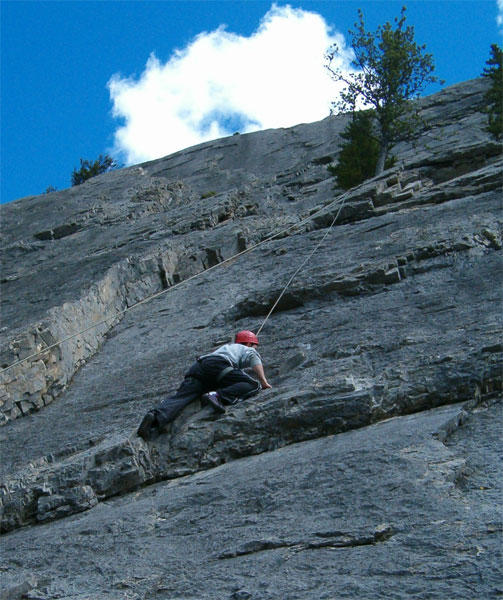
That's my brother Doug working his way up the Unnamed 5.6 at Abraham Slabs. Been on a Gym wall exactly once and I forced him to climb 27m of sharp Rockies' limestone; and I didn't even feel guilty.
***
For more pics of this summer's activities, check out a selection at Macblaze or the whole online catalogue on my online image gallery.
I must say I wouldn't have predicted that climbing would be come such a fascination. I guess it has something to do with the unique mixture of challenge, fear, nature and opportunity to grow. I've always believed that life was about growing and learning. That if any universalraison d'etre, metaphysical or otherwise existed then it was to be more tomorrow than we were today. As with so much in life, learning can become stagnant, growth can become plodding progress and the increments can disappear into day-to-day details that leave no trace that they even exist. Mostly though, I thought of this a spiritiual or intellecual goal.
I'm not really into sports or physical competition but I've always understood that they provide an outlet for growth outside the self. For those lucky few whose bodies become a finely tuned tool, the nature of "sports" allows both the body and mind to continue to expand, explore and excel every day and honestly there are days when I am a bit jealous of that. I occasionaly remember that in our modern society, we have a tendency to elevate intellectual pursuits a bit too much. Ballet is nothing more than an exquisite blend of the body's potential and the mind's capacity--a lot like watching Wayne Gretzky on a breakaway if you can just shift you view 90 degrees.
Let's give credit where credit is due. All those high school jocks and beer league heros have learned to to grow and learn in a way that some of us never have. I've never minded a good game of catch, wasting an afternood at frisbee or a splash in the pool, but its always been as mindless as a classic episode of Three's Company. Playing sports is like watching sitcoms of reading a good trashy romance, fun but ultimately just a way to while away the afternoon. Still, I can picture a few moments from the past: my old friend Mitch, poised between 2nd and 3rd, snatching the ball out of the air and oh so gracefully pirouetting to land nimbley and blast the ball across the infield to make the play. I know it wasn't mindless because I grew up watching him push and push those skills so his body would do exactly what his mind told it to. I was alway just too worried about whether I could actually stop the stupid ball to wonder what I was going to do with it next. He grew, I watched.
All this is to say that I think I've found in climbing a way to push my body to learn and grow not because I want to be a jock or spray about my latest rock conquest, but because it is becoming a tool that allows me to focus my thoughts and learn to exist in a whole new way. There is something very, very unique about being 20m up a rock slab that you know you can't climb, know you can't descend, know you can't fall from and know you can't just cling to. I've said it to L quite a few times now..."that scared the hell out of me!" and followed up with a smile. "Scared" is definitely not the right word although if you can conceive of fear as a power for good, something to actually strive for, then you'd be close.
There is something inexplicable that occurs when you get all of your processes working in synch. The human psyche is is a construct of nerves and neurons, habits and hormones. I'm beginning to believe that if one can only get the system working together... if thought, perception, imagination, instinct, strength, flexibility, if all the elements that make the machine work are working in harmony, then it doesn't matter the level at which you perform, whether mental giant and world class power lifter or city bus driver and newspaper proofreader, what matters is that the system itself works and continues to grow, to work "stronger, faster, better" and that we learn to celebrate that.
I'll never aspire to being Chris Sharma, a lot of things I've read and done lately are allowing me to center my new addiction within my self: I grow, everyday. I think in the end, Jake's quote (above: "climbing is a sick addiction...") sums it up well when it ends with, "Other than that, it is just plain fun."
It is.
Thursday, July 07, 2005
Kibbles and Bits
I am currently taking a graduate course in curriculum foundations. It's very interesting, but my brain is tired. Here are some bits and pieces to mull over. Meanwhile, I'm working on a little project about pedagogy and the album The Dreaming. I'll probably post it once I've presented it. Watch out! —L
Sadly, the history of language is too often a collapse of words for action into words for things. —Madeleine R. Grumet
From CBC Edmonton: Foothills-Rocky View MLA Ted Morton says if the province doesn't fight the legislation, homosexuality will creep into the mainstream and those that don't agree will be discriminated against. "If gay marriage has full support of both federal and provincial law, it would be very difficult, for example, for a teacher at a high school or junior high to refuse to teach this as part of the curriculum that presents this as normal," Ted Morton said.
Give me a break
Oh, let me try
Give me something to show for my miserable life
Something to take
Would you break even my wings, like a swallow?
— Kate Bush, "Night of the Swallow"
I am currently taking a graduate course in curriculum foundations. It's very interesting, but my brain is tired. Here are some bits and pieces to mull over. Meanwhile, I'm working on a little project about pedagogy and the album The Dreaming. I'll probably post it once I've presented it. Watch out! —L
Sadly, the history of language is too often a collapse of words for action into words for things. —Madeleine R. Grumet
From CBC Edmonton: Foothills-Rocky View MLA Ted Morton says if the province doesn't fight the legislation, homosexuality will creep into the mainstream and those that don't agree will be discriminated against. "If gay marriage has full support of both federal and provincial law, it would be very difficult, for example, for a teacher at a high school or junior high to refuse to teach this as part of the curriculum that presents this as normal," Ted Morton said.
Give me a break
Oh, let me try
Give me something to show for my miserable life
Something to take
Would you break even my wings, like a swallow?
— Kate Bush, "Night of the Swallow"
Friday, June 24, 2005
Nothing to lose but your chains
Karl Marx was a Taurus. That's all anyone needs to know.
"Today 50 of the largest 100 economies in the world are run by multinationals, not by countries. Mitsubishi is bigger than Saudi Arabia; General Motors is larger than either Greece, Norway or South Africa. The combined annual revenues of the biggest 200 corporations are greater than those of 182 nation-states that contain 80 per cent of the world's population." — Wayne Ellwood in The No-Nonsense Guide to Globalization
According to the latest preliminary estimates released by R.R. Bowker, the total title output in American publishing increased 14 percent in 2004/5 to a new high of 195,000 — up from 135,000 titles only three years ago, although the 2004/5 increase is less than 2003/4's 19-percent jump. Source: Publishers Lunch, May 2005
Yes, it's 1:37 AM and I'm wide awake. Sigh. Still reading lots and lots. I believe I will reach my 50-book goal before the end of June, thereby setting me up to read 100 books this year — some of them even big books! Meanwhile, I'm contemplating dyeing my hair dark, dark brown. Hmm. Did I mention that I'm currently the acting chair in my dept? Once again, the key to the executive washroom dangles mere centimetres from my curious fingers...
Eliminate the metaphor of violence. Incense and lollipops. Find a man who is not. Violets and rosemary. Morning glories opening in August. Am I already a ghost? The taste of the wind, the blackberries of memory.
Somnambulantly,
L
Karl Marx was a Taurus. That's all anyone needs to know.
"Today 50 of the largest 100 economies in the world are run by multinationals, not by countries. Mitsubishi is bigger than Saudi Arabia; General Motors is larger than either Greece, Norway or South Africa. The combined annual revenues of the biggest 200 corporations are greater than those of 182 nation-states that contain 80 per cent of the world's population." — Wayne Ellwood in The No-Nonsense Guide to Globalization
According to the latest preliminary estimates released by R.R. Bowker, the total title output in American publishing increased 14 percent in 2004/5 to a new high of 195,000 — up from 135,000 titles only three years ago, although the 2004/5 increase is less than 2003/4's 19-percent jump. Source: Publishers Lunch, May 2005
Yes, it's 1:37 AM and I'm wide awake. Sigh. Still reading lots and lots. I believe I will reach my 50-book goal before the end of June, thereby setting me up to read 100 books this year — some of them even big books! Meanwhile, I'm contemplating dyeing my hair dark, dark brown. Hmm. Did I mention that I'm currently the acting chair in my dept? Once again, the key to the executive washroom dangles mere centimetres from my curious fingers...
Eliminate the metaphor of violence. Incense and lollipops. Find a man who is not. Violets and rosemary. Morning glories opening in August. Am I already a ghost? The taste of the wind, the blackberries of memory.
Somnambulantly,
L
Wednesday, June 15, 2005
Words, words, words
Just finished Dating Hamlet: Ophelia's Story by Lisa Fiedler, a playful retelling of Hamlet. Most of the action of the novel takes place between the scenes of the play. In this version, Ophelia is an amateur botanist (she calls herself an alchemist) and soon to be Hamlet's wife (in a nicely understated scene, she gives up her "virtue" to him, shortly before he appears mad before the court). The novel reveals a different reason for Ophelia's purported madness (like Hamlet's, it is a feigned "antic disposition") and offers an extended ending to the play's conclusion, beginning once the bodies of Hamlet, Laertes, and the Queen are taken to the castle morgue. Purists would cringe, but I like the more positive re-imagining of Hamlet and Ophelia's fate -- much like Ann-Marie MacDonald's reinterpretation of Desdemona's and Juliet's roles. My only complaint with the novel is the dialogue: it's roundly awful. Imagine, if you can, a California high school as Hollywood has repeatedly presented them to us; then imagine the students of that high school attempting to write Elizabethan conversation without the guidance of an educated adult. "Verily, a few knights short of a crusade," indeed. But that's a small quibble. Female YA readers would likely enjoy this work. It's certainly more accessible than Shylock's Daughter, Mirjam Pressler's serious but thoughtful retelling of The Merchant of Venice.
Earlier this week, I finished The Meaning of Wife by Anne Kingston. This is an astonishingly well-constructed cultural history of the term wife, ending with a hopeful, albeit less than plausible, call for change to our understanding of one of society's oldest roles. I recommend this book highly.
Over the weekend I finished Isabel Allende's Zorro, her richly developed portrait of Diego de la Vega's youth and education. As with most of Allende's work, this novel is romantic and energetic, with lush, detailed description and clever ties to contemporary issues. Although it's almost 400 pages long, it moves quickly. Excellent summer reading, although perhaps not quite vintage Allende.
Meanwhile, in other news (source: CBC online)
Andy Russell, one of the province's best-known conservationists and storytellers, has died. He was 89.
I remember listening to Andy Russell's series Our Alberta Heritage on the radio when I was growing up. Russell represented a compassionate spirit in Alberta, something too often lacking in our current society. I was sad to hear he had died.
Finola Hackett, a 13-year-old Tofield girl who made it to the championship round of the Scripps National Spelling Bee, was stumped Thursday afternoon by the word nisse – a Scandinavian brownie that frequents barns. Before missing her final word, she successfully spelled these other words:
• heterocoelous (a type of vertebrae)
• verticil (parts arranged in a circle around an axis)
• whiffet (a small or unimportant person)
• merotomize (to divide into parts)
• cassowary (a large, flightless, Australian bird)
• fumulus (a cloud that forms over smokestacks)
• blepharoptosis (a drooping of the upper eyelid).
I doubt that I could have spelled ANY of those words. Eeks, what a smart girl!
On the left hand
The Tyee continues to offer provocative alternative media from Canada's West Coast. This week one of their editorialists wrote an article titled "Canada's Stupid Party," about the disaster the "ReformaTories" have revealed themselves to be. Here's an excerpt:
Here’s a party that has serious credibility problems when it comes to convincing women they’re not a bunch of sexist neanderthals. Their most prominent woman walks across the floor and when all the cameras and microphones are pointed at them, the best attack they can muster is that their biggest female star was an ambitious, stupid, heartbreaking whore. Yeah, that’s gonna convince all Canadian women that you’ve got their best interests at heart.
The rest of the article is here. Definitely worth your time. Another article in the same issue, coyly title "Meet the Genitailor," profiles a Vancouver-based plastic surgeon who specializes in gynecological retrofitting. Chilling and disturbing — see it here if you don't mind reading something fairly graphic and anti-feminist. Sigh.
Odds and ends
Some thoughts to fill your mind and soothe your soul. A bientôt!
Fill your paper with the breathings of your heart. —William Wordsworth
When you re-read a classic you do not see in the book more than you did before. You see more in you than there was before. —Clifton Fadiman
The best thing one can do when it's raining is to let it rain. —Henry Wadsworth Longfellow
Leslie
Just finished Dating Hamlet: Ophelia's Story by Lisa Fiedler, a playful retelling of Hamlet. Most of the action of the novel takes place between the scenes of the play. In this version, Ophelia is an amateur botanist (she calls herself an alchemist) and soon to be Hamlet's wife (in a nicely understated scene, she gives up her "virtue" to him, shortly before he appears mad before the court). The novel reveals a different reason for Ophelia's purported madness (like Hamlet's, it is a feigned "antic disposition") and offers an extended ending to the play's conclusion, beginning once the bodies of Hamlet, Laertes, and the Queen are taken to the castle morgue. Purists would cringe, but I like the more positive re-imagining of Hamlet and Ophelia's fate -- much like Ann-Marie MacDonald's reinterpretation of Desdemona's and Juliet's roles. My only complaint with the novel is the dialogue: it's roundly awful. Imagine, if you can, a California high school as Hollywood has repeatedly presented them to us; then imagine the students of that high school attempting to write Elizabethan conversation without the guidance of an educated adult. "Verily, a few knights short of a crusade," indeed. But that's a small quibble. Female YA readers would likely enjoy this work. It's certainly more accessible than Shylock's Daughter, Mirjam Pressler's serious but thoughtful retelling of The Merchant of Venice.
Earlier this week, I finished The Meaning of Wife by Anne Kingston. This is an astonishingly well-constructed cultural history of the term wife, ending with a hopeful, albeit less than plausible, call for change to our understanding of one of society's oldest roles. I recommend this book highly.
Over the weekend I finished Isabel Allende's Zorro, her richly developed portrait of Diego de la Vega's youth and education. As with most of Allende's work, this novel is romantic and energetic, with lush, detailed description and clever ties to contemporary issues. Although it's almost 400 pages long, it moves quickly. Excellent summer reading, although perhaps not quite vintage Allende.
Meanwhile, in other news (source: CBC online)
Andy Russell, one of the province's best-known conservationists and storytellers, has died. He was 89.
I remember listening to Andy Russell's series Our Alberta Heritage on the radio when I was growing up. Russell represented a compassionate spirit in Alberta, something too often lacking in our current society. I was sad to hear he had died.
Finola Hackett, a 13-year-old Tofield girl who made it to the championship round of the Scripps National Spelling Bee, was stumped Thursday afternoon by the word nisse – a Scandinavian brownie that frequents barns. Before missing her final word, she successfully spelled these other words:
• heterocoelous (a type of vertebrae)
• verticil (parts arranged in a circle around an axis)
• whiffet (a small or unimportant person)
• merotomize (to divide into parts)
• cassowary (a large, flightless, Australian bird)
• fumulus (a cloud that forms over smokestacks)
• blepharoptosis (a drooping of the upper eyelid).
I doubt that I could have spelled ANY of those words. Eeks, what a smart girl!
On the left hand
The Tyee continues to offer provocative alternative media from Canada's West Coast. This week one of their editorialists wrote an article titled "Canada's Stupid Party," about the disaster the "ReformaTories" have revealed themselves to be. Here's an excerpt:
Here’s a party that has serious credibility problems when it comes to convincing women they’re not a bunch of sexist neanderthals. Their most prominent woman walks across the floor and when all the cameras and microphones are pointed at them, the best attack they can muster is that their biggest female star was an ambitious, stupid, heartbreaking whore. Yeah, that’s gonna convince all Canadian women that you’ve got their best interests at heart.
The rest of the article is here. Definitely worth your time. Another article in the same issue, coyly title "Meet the Genitailor," profiles a Vancouver-based plastic surgeon who specializes in gynecological retrofitting. Chilling and disturbing — see it here if you don't mind reading something fairly graphic and anti-feminist. Sigh.
Odds and ends
Some thoughts to fill your mind and soothe your soul. A bientôt!
Fill your paper with the breathings of your heart. —William Wordsworth
When you re-read a classic you do not see in the book more than you did before. You see more in you than there was before. —Clifton Fadiman
The best thing one can do when it's raining is to let it rain. —Henry Wadsworth Longfellow
Leslie
Saturday, May 28, 2005
Done with all of that...
Today's wise words, courtesy of William Styron...
To most of those who have experienced it, the horror of depression is so overwhelming as to be quite beyond expression, hence the frustrated sense of inadequacy found in the work of even the greatest artists. But in science and art the search will doubtless go on for a clear representation of its meaning, which sometimes, for those who have known it, is a simulacrum of all the evil of our world: of our everyday discord and chaos, our irrationality, warfare and crime, torture and violence, our impulse toward death and our flight from it held in the intolerable equipoise of history.
Wow. "The intolerable equipoise of history." What a brilliant line. Don't you wish you had written that? The excerpt comes from his long personal essay Darkness Visible: A Memoir of Madness. It's a harrowing, articulate exploration of his experience with depression at age sixty. Highly recommended.
And on the lighter side of life...
Away, you scullion! You rampallion! You fustilarian! I'll tickle your catastrophe. — Falstaff in Henry IV
Fun fact...
Scholastic says they will print 10.8 million copies of the regular trade edition of HARRY POTTER AND THE HALF-BLOOD PRINCE. — Publishers Lunch
Pace, Dr M...
Peace. It does not mean to be in a place where there is no noise, trouble or hard work. It means to be in the midst of those things and still be calm in your heart. — Source Unknown
Saw Humble Boy last night — wonderful! B is climbing in Nordegg today — he'll have to post about the experience later. Taught a fun pick-up class for a colleague today — my last official teaching this academic year! Had a lovely maguro don for supper tonight. All is clearly right with the world.
Putting on my walking shoes...
L
Today's wise words, courtesy of William Styron...
To most of those who have experienced it, the horror of depression is so overwhelming as to be quite beyond expression, hence the frustrated sense of inadequacy found in the work of even the greatest artists. But in science and art the search will doubtless go on for a clear representation of its meaning, which sometimes, for those who have known it, is a simulacrum of all the evil of our world: of our everyday discord and chaos, our irrationality, warfare and crime, torture and violence, our impulse toward death and our flight from it held in the intolerable equipoise of history.
Wow. "The intolerable equipoise of history." What a brilliant line. Don't you wish you had written that? The excerpt comes from his long personal essay Darkness Visible: A Memoir of Madness. It's a harrowing, articulate exploration of his experience with depression at age sixty. Highly recommended.
And on the lighter side of life...
Away, you scullion! You rampallion! You fustilarian! I'll tickle your catastrophe. — Falstaff in Henry IV
Fun fact...
Scholastic says they will print 10.8 million copies of the regular trade edition of HARRY POTTER AND THE HALF-BLOOD PRINCE. — Publishers Lunch
Pace, Dr M...
Peace. It does not mean to be in a place where there is no noise, trouble or hard work. It means to be in the midst of those things and still be calm in your heart. — Source Unknown
Saw Humble Boy last night — wonderful! B is climbing in Nordegg today — he'll have to post about the experience later. Taught a fun pick-up class for a colleague today — my last official teaching this academic year! Had a lovely maguro don for supper tonight. All is clearly right with the world.
Putting on my walking shoes...
L
Monday, May 23, 2005
Wise words
In the wake of last week's very close confidence vote, I have read a great deal of ho-hum political analysis. In my opinion, though, this excerpt is rather insightful. (See Why Conservatives Should Thank Chuck Cadman for the full story.)
As for the leader of the loyal opposition, Stephen Harper just doesn't get it. Hidden in the media spin surrounding the budget votes yesterday is all the evidence the Conservative Party needs to rid itself of the man who cannot possibly win them power. Far be it from me to help this Reform/Alliance retread party be more effective, given its draconian, hidden agenda. But the fact is, this extremist agenda is exactly what Harper brings to the party. If the Conservatives actually chose someone from the old Progressive Conservative wing of their party as leader, not only would they do better, but Canada would not be constantly threatened by Harper's vision of creating a carbon copy of the US north of the border. While Harper is almost pathologically committed to an American vision of the country, what's left of the old PCs -- especially the Red Tories -- might just have enough good sense left to recognize that Canadians are moving to the left in their values and policy preferences.
Meanwhile, in another part of my brain...
So difficult it is to show the various meanings and imperfections of words when we have nothing else but words to do it with. —John Locke, philosopher (1632-1704)
I've been writing a little lately, not all of it course proposals and evasive e-mail. Overall I'm still mostly exhausted and periodically lost. But on the bright side, I start holidays on the 29th, so I can sleep a lot then.
The weather here is rainy and cool, but most of the garden has come into leaf. You'll never believe what I found at the grocery yesterday: blackberries! They were delicious. Tonight I made ribs for dinner, one of Zak's favourites. Soon I may work up the energy to clean house or sew my summer dresses; or perhaps I'll get my mom to sew them after all. Hmm... : )
Today I like: buffalo, green days, long straight highways, blue gingham, sunflower seeds, mortarboards, and September 1.
Now reading: Adultery by Richard B. Wright (not enjoying it), Toxic Sludge Is Good for You! by John Stauber and Sheldon Rampton (it's eye-opening), and Darkness Visible: A Memoir of Madness by William Styron (just beginning). Just finished An Alchemy of Mind by Diane Ackerman (not nearly as good as A Mind of Its Own: The Cultural History of the Penis, which I finished last week). I ordered a book called Who Killed Shakespeare? by Patrick Brantlinger — excellent fodder for my dissertation, from what I've read of it. So many books! But remember that I'm always looking for other suggestions, please.
Oh, and I forgot to mention that B's book What Grows Here was nominated for Trade Book of the Year at the Book Publishers' awards. It didn't win, unfortunately, but it should have. Oh well, there's another volume for next year!
Happy belated birthday to the Taureans! I hope you all have a wonderful year.
That's it: time to get ready for bed. Be well.
L
In the wake of last week's very close confidence vote, I have read a great deal of ho-hum political analysis. In my opinion, though, this excerpt is rather insightful. (See Why Conservatives Should Thank Chuck Cadman for the full story.)
As for the leader of the loyal opposition, Stephen Harper just doesn't get it. Hidden in the media spin surrounding the budget votes yesterday is all the evidence the Conservative Party needs to rid itself of the man who cannot possibly win them power. Far be it from me to help this Reform/Alliance retread party be more effective, given its draconian, hidden agenda. But the fact is, this extremist agenda is exactly what Harper brings to the party. If the Conservatives actually chose someone from the old Progressive Conservative wing of their party as leader, not only would they do better, but Canada would not be constantly threatened by Harper's vision of creating a carbon copy of the US north of the border. While Harper is almost pathologically committed to an American vision of the country, what's left of the old PCs -- especially the Red Tories -- might just have enough good sense left to recognize that Canadians are moving to the left in their values and policy preferences.
Meanwhile, in another part of my brain...
So difficult it is to show the various meanings and imperfections of words when we have nothing else but words to do it with. —John Locke, philosopher (1632-1704)
I've been writing a little lately, not all of it course proposals and evasive e-mail. Overall I'm still mostly exhausted and periodically lost. But on the bright side, I start holidays on the 29th, so I can sleep a lot then.
The weather here is rainy and cool, but most of the garden has come into leaf. You'll never believe what I found at the grocery yesterday: blackberries! They were delicious. Tonight I made ribs for dinner, one of Zak's favourites. Soon I may work up the energy to clean house or sew my summer dresses; or perhaps I'll get my mom to sew them after all. Hmm... : )
Today I like: buffalo, green days, long straight highways, blue gingham, sunflower seeds, mortarboards, and September 1.
Now reading: Adultery by Richard B. Wright (not enjoying it), Toxic Sludge Is Good for You! by John Stauber and Sheldon Rampton (it's eye-opening), and Darkness Visible: A Memoir of Madness by William Styron (just beginning). Just finished An Alchemy of Mind by Diane Ackerman (not nearly as good as A Mind of Its Own: The Cultural History of the Penis, which I finished last week). I ordered a book called Who Killed Shakespeare? by Patrick Brantlinger — excellent fodder for my dissertation, from what I've read of it. So many books! But remember that I'm always looking for other suggestions, please.
Oh, and I forgot to mention that B's book What Grows Here was nominated for Trade Book of the Year at the Book Publishers' awards. It didn't win, unfortunately, but it should have. Oh well, there's another volume for next year!
Happy belated birthday to the Taureans! I hope you all have a wonderful year.
That's it: time to get ready for bed. Be well.
L
Wednesday, May 18, 2005
Coming back online...
Hello, hello. A long time since I've posted. Sorry. Somehow in the laundry of my brain, I got trapped in a spin cycle. Oh dear, quite wrinkled now. Ahem.
Here are some recent magpie wanderings. I'll try to post something more coherent soon.
Barry Schwartz, author of The Paradox of Choice, observes that "not all choice enhances freedom. In particular, increased choice among goods and services may contribute little or nothing to the kind of freedom that counts. Indeed, it may impair freedom by taking time and energy we'd be better off devoting to other matters." This quotation explains the conundrum of grocery shopping.
In A Mind of Its Own,David M. Friedman notes that "Over time the penis has been deified, demonized, secularized, racialized, psychoanalyzed, politicized, and, finally, medicalized...." Great book, by the way!
An anonymous journalism student recently told me, "Among my many duties and responsibilities, I have many unpleasant and strange encounters with customers, employees, and of course, ex-boyfriends." Ah, retail.
And finally, Francesco Petrarch commented, "Five great enemies to peace inhabit with us: avarice, ambition, envy, anger, and pride. If those enemies were to be banished, we should infallibly enjoy perpetual peace."
Somewhere among these ideas is a kind of sense I can currently understand. And you?
L
Hello, hello. A long time since I've posted. Sorry. Somehow in the laundry of my brain, I got trapped in a spin cycle. Oh dear, quite wrinkled now. Ahem.
Here are some recent magpie wanderings. I'll try to post something more coherent soon.
Barry Schwartz, author of The Paradox of Choice, observes that "not all choice enhances freedom. In particular, increased choice among goods and services may contribute little or nothing to the kind of freedom that counts. Indeed, it may impair freedom by taking time and energy we'd be better off devoting to other matters." This quotation explains the conundrum of grocery shopping.
In A Mind of Its Own,David M. Friedman notes that "Over time the penis has been deified, demonized, secularized, racialized, psychoanalyzed, politicized, and, finally, medicalized...." Great book, by the way!
An anonymous journalism student recently told me, "Among my many duties and responsibilities, I have many unpleasant and strange encounters with customers, employees, and of course, ex-boyfriends." Ah, retail.
And finally, Francesco Petrarch commented, "Five great enemies to peace inhabit with us: avarice, ambition, envy, anger, and pride. If those enemies were to be banished, we should infallibly enjoy perpetual peace."
Somewhere among these ideas is a kind of sense I can currently understand. And you?
L
Tuesday, April 12, 2005
Wednesday, March 23, 2005
Inspired
The article that follows is adapted from the editorial I have just written for Active Voice, the national newsletter of the Editors' Association of Canada, of which I am co-editor. (It's only a couple of weeks overdue.) I submit these thoughts about the state of our language for your blogging pleasure — please feel free to comment. A more typically quirky post is sure to follow soon, once I get some sleep... Enjoy! — L
Do you want to banish buzzwords? I have to admit, sometimes I do.
Back in January, Lake Superior State University published its annual Banished Words list. As I do most years, I reviewed the 2005 list with vigorous agreement.
Amid an array of US election-inspired catchphrases, this year's list features the ubiquitous über, the notorious wardrobe malfunction, the well-trod journey, and neologisms blog and webinar. Some of these coinages are indeed trite and uninspired, and while reading the list, I felt a community among sticklers for careful usage.
After all, what's at stake is nicely observed by writer and editor William Zinsser: "our love of the language's beautiful precision." Flat, soggy expressions like safe and effective, sale event, and all new diminish our ability to express ourselves by giving us clichés, pat solutions. We must guard against such vague misdirection; the LSSU list reminds us to be vigilant with our diction (as Don Miguel Ruiz would say, "impeccable" with our words).
But a line in a profile that my student, Sophie Lees, wrote got me thinking about the deeper implications of banishment. Sophie observes that, in Chinese publications, Taiwan must be referred to as a part of China; Taiwan's independence must not be suggested, or the government may censor the document — may even shut the publication down. Watching China's increasingly tense relationship with Taiwan, I know these are not idle threats — they mask a much more serious political reality, symbolized in points of phrasing.
Editors, writers, teachers, and others who care about our language may find buzzwords boring, but do we really want to banish them? And if we do, are we prepared to live with the greater implications of that attitude? Those who work with words recognize the power inherent in them; as history has shown, it takes only a few steps to move from banishing words to censoring ideas, from censoring ideas to banishing those who think them.
According to Zinsser, editors tend to be "liberal in accepting new words and phrases, but conservative in grammar." That seems like the right balance. Grammar is the necessary structure that allows us to communicate efficiently; no matter what vocabulary we adopt, we need secure syntax to carry our thoughts. We might not like über-shizzle-mastic language, but we can understand it — and then we can choose not to use it. What will our choices be if we banish words, even in play? For we know the metaphor has a lived reality in equal rights activists-cum-bra burners and freedom fighters-cum-terrorists.
I still don't like buzzwords, but I suppose they're like junk food. Now and then I can indulge. But do you think I can eat just one?
The article that follows is adapted from the editorial I have just written for Active Voice, the national newsletter of the Editors' Association of Canada, of which I am co-editor. (It's only a couple of weeks overdue.) I submit these thoughts about the state of our language for your blogging pleasure — please feel free to comment. A more typically quirky post is sure to follow soon, once I get some sleep... Enjoy! — L
Do you want to banish buzzwords? I have to admit, sometimes I do.
Back in January, Lake Superior State University published its annual Banished Words list. As I do most years, I reviewed the 2005 list with vigorous agreement.
Amid an array of US election-inspired catchphrases, this year's list features the ubiquitous über, the notorious wardrobe malfunction, the well-trod journey, and neologisms blog and webinar. Some of these coinages are indeed trite and uninspired, and while reading the list, I felt a community among sticklers for careful usage.
After all, what's at stake is nicely observed by writer and editor William Zinsser: "our love of the language's beautiful precision." Flat, soggy expressions like safe and effective, sale event, and all new diminish our ability to express ourselves by giving us clichés, pat solutions. We must guard against such vague misdirection; the LSSU list reminds us to be vigilant with our diction (as Don Miguel Ruiz would say, "impeccable" with our words).
But a line in a profile that my student, Sophie Lees, wrote got me thinking about the deeper implications of banishment. Sophie observes that, in Chinese publications, Taiwan must be referred to as a part of China; Taiwan's independence must not be suggested, or the government may censor the document — may even shut the publication down. Watching China's increasingly tense relationship with Taiwan, I know these are not idle threats — they mask a much more serious political reality, symbolized in points of phrasing.
Editors, writers, teachers, and others who care about our language may find buzzwords boring, but do we really want to banish them? And if we do, are we prepared to live with the greater implications of that attitude? Those who work with words recognize the power inherent in them; as history has shown, it takes only a few steps to move from banishing words to censoring ideas, from censoring ideas to banishing those who think them.
According to Zinsser, editors tend to be "liberal in accepting new words and phrases, but conservative in grammar." That seems like the right balance. Grammar is the necessary structure that allows us to communicate efficiently; no matter what vocabulary we adopt, we need secure syntax to carry our thoughts. We might not like über-shizzle-mastic language, but we can understand it — and then we can choose not to use it. What will our choices be if we banish words, even in play? For we know the metaphor has a lived reality in equal rights activists-cum-bra burners and freedom fighters-cum-terrorists.
I still don't like buzzwords, but I suppose they're like junk food. Now and then I can indulge. But do you think I can eat just one?
Wednesday, March 16, 2005
Monday, February 28, 2005
It came from the marking pile...
In Distilled Prose last week, my students were given a two-part in-class assignment. In pairs, they were to write a complaint letter on the subject of their choosing. Each pair then received another pair's complaint letter to respond to. The pairs had 30 minutes to complete each component of the assignment.
This one was at the bottom of the pile...
Dear Ms V———:
Your name is too hard to spell. For the convenience of the class members (many of whom, despite being in professional writing, can't write) please eliminate at least two, if not upwards of four letters from your surname. We suggest ditching everything but Erm or Eer.
Think of the advantages: Your name would no longer be called last; your car registration renewal date would change, possibly to a much better and convenient time. And those annoying syllables? Think of the time you would be saving yourself and others around you by cutting your name down to one syllable.
Another bit of ridiculousness that must come to an abrupt halt is your pretentious habit of capitalizing the first letter of "Leslie". Who do you think you are? We don't know who "lie" is, but your insistence of having "les" of her borders on the absurd. It's a self-indulgent number of L's anyway. Two? Honestly. eslie Erm just rolls off the tongue. eslie Erm. eslie Erm. It has a certain amount of quiet dignity, a certain intangible X-factor, a certain je ne sais quoi. Plus it's wickedly alliterative and it's completely unique. We don't think there are any other eslie Erm's on this earth. Even if there were, they wouldn't be as cool as you. Come to think of it, you'd have to be stupid NOT to change your name to eslie Erm.
To conclude, we truly believe that it would be beneficial for you to become known as "eslie Erm".
Sincerely yours,
Pair XY
On my behalf, Pair XX replied...
Dear Pair XY:
Thank you for your letter. While creative and comical, it is completely unjustified. As a full-time professor of the PROFESSIONAL Writing Program, it is my duty to weed out the weakest links. The fact that you can't grasp the spelling of my name goes against every inch of my writer's being. It's spelled just like it sounds.
However, I will concede that others have had problems with the spelling. I also had problems learning how to spell it, but then again I was six.
Your suggestion that having a last name closer to the beginning of the alphabet is noted. However, sometimes they start at the end of the alphabet, in which case "V———" is very advantageous. Moreover, I was named after my great-great-great grandmother and the honour and tradition seem much more valuable than the few extra seconds I would save by changing my name.
As far as your "ridiculousness" goes, Leslie or Eslie is a proper noun, thereby requiring capitalization. You asked me who I thought I was. My answer is quite simple. I am L——— V——— and I prefer you call me that.
Once again thanks for your letter. It's so much easier to sustain the quality of graduates when the "slow" students find me. To learn the proper spelling of my name I suggest you look up my office hours.
Sincerely,
L---- V------
So there!
In Distilled Prose last week, my students were given a two-part in-class assignment. In pairs, they were to write a complaint letter on the subject of their choosing. Each pair then received another pair's complaint letter to respond to. The pairs had 30 minutes to complete each component of the assignment.
This one was at the bottom of the pile...
Dear Ms V———:
Your name is too hard to spell. For the convenience of the class members (many of whom, despite being in professional writing, can't write) please eliminate at least two, if not upwards of four letters from your surname. We suggest ditching everything but Erm or Eer.
Think of the advantages: Your name would no longer be called last; your car registration renewal date would change, possibly to a much better and convenient time. And those annoying syllables? Think of the time you would be saving yourself and others around you by cutting your name down to one syllable.
Another bit of ridiculousness that must come to an abrupt halt is your pretentious habit of capitalizing the first letter of "Leslie". Who do you think you are? We don't know who "lie" is, but your insistence of having "les" of her borders on the absurd. It's a self-indulgent number of L's anyway. Two? Honestly. eslie Erm just rolls off the tongue. eslie Erm. eslie Erm. It has a certain amount of quiet dignity, a certain intangible X-factor, a certain je ne sais quoi. Plus it's wickedly alliterative and it's completely unique. We don't think there are any other eslie Erm's on this earth. Even if there were, they wouldn't be as cool as you. Come to think of it, you'd have to be stupid NOT to change your name to eslie Erm.
To conclude, we truly believe that it would be beneficial for you to become known as "eslie Erm".
Sincerely yours,
Pair XY
On my behalf, Pair XX replied...
Dear Pair XY:
Thank you for your letter. While creative and comical, it is completely unjustified. As a full-time professor of the PROFESSIONAL Writing Program, it is my duty to weed out the weakest links. The fact that you can't grasp the spelling of my name goes against every inch of my writer's being. It's spelled just like it sounds.
However, I will concede that others have had problems with the spelling. I also had problems learning how to spell it, but then again I was six.
Your suggestion that having a last name closer to the beginning of the alphabet is noted. However, sometimes they start at the end of the alphabet, in which case "V———" is very advantageous. Moreover, I was named after my great-great-great grandmother and the honour and tradition seem much more valuable than the few extra seconds I would save by changing my name.
As far as your "ridiculousness" goes, Leslie or Eslie is a proper noun, thereby requiring capitalization. You asked me who I thought I was. My answer is quite simple. I am L——— V——— and I prefer you call me that.
Once again thanks for your letter. It's so much easier to sustain the quality of graduates when the "slow" students find me. To learn the proper spelling of my name I suggest you look up my office hours.
Sincerely,
L---- V------
So there!
Purple Monday
Stretch your toes up to the sun, to the stars. Open the black night and find deepest primrose inside. There are undiscovered moons. The eyes of evening stretched, squinting: we cannot be seen in the dusk of dreams. Urgent silence. Where have you been walking tonight?
You can see the wrens fluttering their wings, truth beating through the fierce wind, the coy sun. Their voices sound like ghosts and they're laughing. Bring your knife: we will press palm to palm and commingle our histories. White daisies all over the meadow, pinks and heliotrope, violets, phlox, wild roses. Regret nothing. The truth may be inscribed only once.
***
Now reading: The Elephants of Style by Bill Walsh: a style and usage manual from a Washington Post copy chief; The Courage to Teach by Parker J. Palmer: a meditation on what teaching really means and also the base text for the teaching diamond I belong to; The Birth of Venus by Sarah Dunant: a fascinating novel about fifteenth-century Florence.
Waiting to read The Paradox of Choice: Why More Is Less, The Dance of Anger, and The Return of Merlin. Et vous? Recommendations are always welcome.
New(ish) listening: How To Dismantle An Atomic Bomb by U2 and The Beekeeper by Tori Amos. Listen deep.
"Peace is all around us. In our world and in nature and within us, in our bodies and our spirits. Once we learn to touch this peace, we will be healed and transformed. It is not a matter of faith, it is a matter of practice." —Thich Nhat Han
With love,
the queen of cups
Stretch your toes up to the sun, to the stars. Open the black night and find deepest primrose inside. There are undiscovered moons. The eyes of evening stretched, squinting: we cannot be seen in the dusk of dreams. Urgent silence. Where have you been walking tonight?
You can see the wrens fluttering their wings, truth beating through the fierce wind, the coy sun. Their voices sound like ghosts and they're laughing. Bring your knife: we will press palm to palm and commingle our histories. White daisies all over the meadow, pinks and heliotrope, violets, phlox, wild roses. Regret nothing. The truth may be inscribed only once.
***
Now reading: The Elephants of Style by Bill Walsh: a style and usage manual from a Washington Post copy chief; The Courage to Teach by Parker J. Palmer: a meditation on what teaching really means and also the base text for the teaching diamond I belong to; The Birth of Venus by Sarah Dunant: a fascinating novel about fifteenth-century Florence.
Waiting to read The Paradox of Choice: Why More Is Less, The Dance of Anger, and The Return of Merlin. Et vous? Recommendations are always welcome.
New(ish) listening: How To Dismantle An Atomic Bomb by U2 and The Beekeeper by Tori Amos. Listen deep.
"Peace is all around us. In our world and in nature and within us, in our bodies and our spirits. Once we learn to touch this peace, we will be healed and transformed. It is not a matter of faith, it is a matter of practice." —Thich Nhat Han
With love,
the queen of cups
Thursday, February 10, 2005
It's been that kind of week...
Sigh. So glad tomorrow is Friday.
Just for entertainment...
“We should read to give our souls a chance to luxuriate.” —Henry Miller
What kind of magical creature are you?
You scored as Faery.
You are beautiful wonder, and you are very wise, yet young and spontaneous at times. You are kind and sweet, but may be somewhat too deeply involved emotionally in frivolous affairs.
Faery 70%
Troll 60%
Witch 50%
Mermaid 45%
Human 40%
Demon 40%
Werewolf 25%
Vampire 20%
Want to know how you would score? Click here.
"If we have no peace, it is because we have forgotten that we belong to each other." —Mother Teresa
Off to sleep now...
L
Sigh. So glad tomorrow is Friday.
Just for entertainment...
“We should read to give our souls a chance to luxuriate.” —Henry Miller
What kind of magical creature are you?
You scored as Faery.
You are beautiful wonder, and you are very wise, yet young and spontaneous at times. You are kind and sweet, but may be somewhat too deeply involved emotionally in frivolous affairs.
Faery 70%
Troll 60%
Witch 50%
Mermaid 45%
Human 40%
Demon 40%
Werewolf 25%
Vampire 20%
Want to know how you would score? Click here.
"If we have no peace, it is because we have forgotten that we belong to each other." —Mother Teresa
Off to sleep now...
L
Monday, January 31, 2005
Love may be blind but lust has a pretty sharp eye
My very own aphorism!
What does a sexy linguist wear on vacation?
A diphthong.
What's invisible and plays hockey?
A ghoulie.
Why was the cannibal expelled from school?
He was buttering up his teacher.
My favourite recent headline: Lawyers challenge Harper's same-sex position —CBC online
Today's thought: Nothing can bring you peace but yourself. —Ralph Waldo Emerson
Words words words
From Jann Arden's "Good Mother"
I’ve got money in my pocket
I like the color of my hair
I’ve got a friend who loves me
Got a house, I’ve got a car
I’ve got a good mother
and her voice is what keeps me here
Feet on ground
Heart in hand
Facing forward
Be yourself
I’ve never wanted anything so bad...so bad
Cardboard masks of all the people
I’ve been
thrown out with all the rusted, tangled
dented god-damned miseries
You could say I’m hard to hold
But if you knew me you’d know
I’ve got a good father
And his strength is what makes me cry
Feet on ground
Heart in hand
Facing forward
Be yourself
I’ve never wanted anything so bad...
***
I hope you are well.
L
My very own aphorism!
What does a sexy linguist wear on vacation?
A diphthong.
What's invisible and plays hockey?
A ghoulie.
Why was the cannibal expelled from school?
He was buttering up his teacher.
My favourite recent headline: Lawyers challenge Harper's same-sex position —CBC online
Today's thought: Nothing can bring you peace but yourself. —Ralph Waldo Emerson
Words words words
From Jann Arden's "Good Mother"
I’ve got money in my pocket
I like the color of my hair
I’ve got a friend who loves me
Got a house, I’ve got a car
I’ve got a good mother
and her voice is what keeps me here
Feet on ground
Heart in hand
Facing forward
Be yourself
I’ve never wanted anything so bad...so bad
Cardboard masks of all the people
I’ve been
thrown out with all the rusted, tangled
dented god-damned miseries
You could say I’m hard to hold
But if you knew me you’d know
I’ve got a good father
And his strength is what makes me cry
Feet on ground
Heart in hand
Facing forward
Be yourself
I’ve never wanted anything so bad...
***
I hope you are well.
L
Subscribe to:
Posts (Atom)

 Posts
Posts


